
For the last few months, our team has been co-designing AI systems with several of our partner brokerages.
Prior to that, my co-founder and I spent many months understanding why 95% of AI systems deliver no measurable value.
In this newsletter edition, I'll share 3 core mindset shifts that every AI transformation company and every brokerage, thinking of adopting AI, needs to understand.
The most valuable knowledge is not on the internet
Frontier AI models have learned from an immense amount of public information from the internet. However, most valuable knowledge when it comes to insurance brokering is not on the internet.
Frontier models alone do not know why your client rejected a plan last year, how to finish a quote when data is incomplete, or the high-cost claimants on particular groups.
That knowledge lives in emails, documents, legacy software, and in people heads. This is a fundamental implementation and data problem, and a newer, more expensive AI model does not bypass this knowledge gap.
The starting point to any AI implementation is to make that knowledge available to the AI system.
The exceptions are the job
Most AI demos follow a clean path. There's an input and a clean output. However, everyone knows that most work, especially in service business, are not like that.
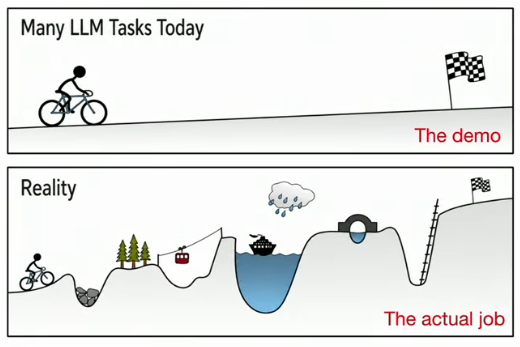
The world of insurance brokering is full of exceptions. The census is incomplete. The carrier rejects a renewal last-minute. The client changes the contribution strategy after the team has already modeled the plans.
This is the reality on a day-to-day basis, and what you see in most AI demos do not translate to how the AI system will perform once it's working with a real book of business.
For any company trying / thinking of AI implementation, this is a necessary mindset shift.
The exceptions are the job.
Earning the right to AI adoption
A lot of AI vendors nowadays start by promising an AI coworker.
At Fidaris, we believe that AI companies need to earn the right to build this coworker, and there are two key parts to this:
Continual learning
One of the hottest trends in Silicon Valley right now is continual learning -- making the agent better over time from feedback. As per my first point in this article, this is a necessity when building AI systems for service businesses, like insurance brokerages.
However, the agent can only get feedback if people use it. Yet, the chicken-and-the-egg situation here is that people only use the agent when it's worth adopting.
Giving your whole company subscriptions to Claude or ChatGPT is not an AI implementation strategy. You could have the best AI coworker in the world, but if the person who's worked at your agency for the last 15 years continues to do things the same way, nothing changes. There's no usage to enable the continual learning in the first place.
So, how do you get usage?
Co-designing with the team
The AI transformation companies we've seen to be actually successful all co-design the AI systems with the team members in the businesses. They learn the processes, behaviours, who handles what, and the business' goals.
We at Fidaris like to take this to the extreme. We fly out to all the agencies we partner with, to get under the same roof, shadow current processes, make iterations to the AI system on the spot, and set up the software on everyone's computers.
Where this leaves us
AI models will continue to get better and become more of a commodity overtime. But the hard part is everything around the models.
If you're a boutique agency owner or at a large national still considering running another AI pilot before deciding on a larger-scale rollout, feel free to DM me about any questions.